Quick answer
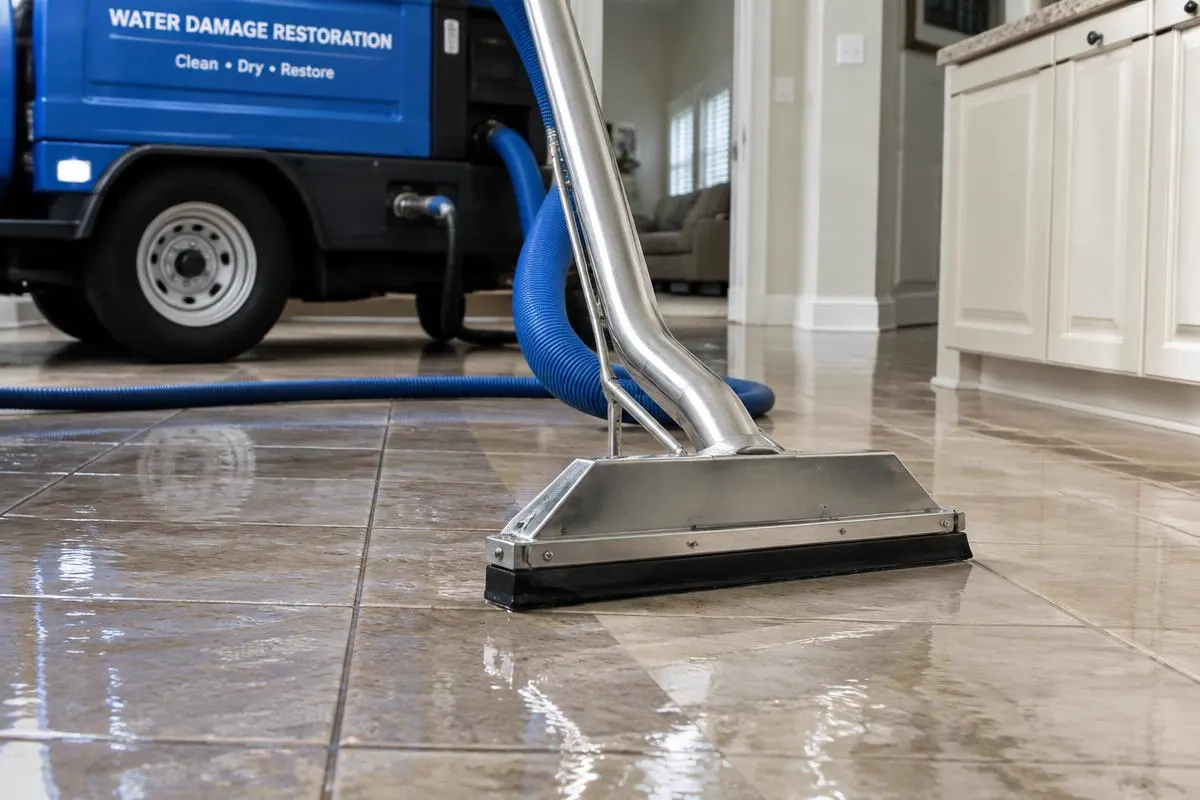
Emergency water removal uses commercial extractors and pumps to pull standing water out of floors, carpet and pad within hours. Removing water fast limits how far it spreads and shortens drying time. We answer 24/7.
What a water removal emergency looks like
Match what you see at home to the signs below.
See all signs of water damage →Standing water on tile
Call nowWater covering tile can travel under cabinets and into adjacent rooms. Stay away from wet outlets and call for removal.
Carpet that squishes
Call nowCarpet that squishes or releases water underfoot is soaked through. The pad beneath it can hold much more water than you see.
Water under kitchen cabinets
Call nowPooling water at cabinet bases can hide a supply-line or appliance leak. It can soak cabinet bottoms and nearby walls.
Wet drywall near the floor
Call nowA dark, wet band along the bottom of a wall shows water spreading through drywall. Removing the puddle alone will not dry the wall.
Why fast water extraction matters
Water does the most damage in the first few hours. It moves outward across subfloors, wicks up drywall a little higher every hour, and soaks into the backing of carpet and the core of laminate and engineered wood. Furniture legs stain carpet. Particleboard cabinets swell and never return to shape. Every gallon you remove early is a gallon that does not have to be dried out of the structure later — which means less demolition, a shorter drying time and a smaller repair bill.
Extraction is also the single most efficient step in the drying process. Removing liquid water mechanically is many times faster than evaporating it with fans and dehumidifiers. That is why the first thing our crew does after making the area safe is extract, extract, extract.
What we use — and why a shop vac isn't enough
We arrive with commercial extraction units that pull water from hard floors, carpet and carpet pad with far more suction than any household or shop vacuum. For carpet, we use weighted extraction tools that press water out of the pad underneath. For larger losses — flooded garages, commercial spaces, homes hit by flash flooding — we bring submersible pumps to move high volumes of water quickly.
A household vacuum is not designed for water and can be an electrical hazard. Even a wet/dry shop vac removes only surface water and leaves the pad and subfloor saturated. If you want to help before we arrive, soak up what you safely can with towels, move valuables to a dry area, and stay out of rooms where water may have reached outlets.
Common reasons for emergency water removal in the Valley
In the Rio Grande Valley, emergency water removal calls tend to spike in two situations: heavy rain events and plumbing failures. When a storm parks over the Valley — like the March 2025 storms that flooded streets in Harlingen and McAllen — water can enter homes through doors, low windows and slab edges in minutes. During hurricane season, tropical rain can overwhelm drainage ditches across Hidalgo and Cameron counties.
The rest of the year, the culprits are usually inside the home: a supply line under the sink that bursts, a water heater tank that fails in the garage or closet, a washing machine hose that splits, or an AC condensate line that backs up and overflows. These leaks often start while the family is asleep or at work, so by the time someone notices there can be an inch of water across several rooms.
- Flash flooding and storm water entering the home
- Burst supply lines and pipes
- Water heater failures
- Washer, dishwasher and ice-maker leaks
- AC drain line and drain pan overflows
- Toilet and tub overflows
What happens after the water is gone
Removing the visible water is step one, not the finish line. After extraction, we measure moisture in walls, floors and cabinets to see how far it traveled. We may need to remove wet carpet pad, cut a flood line in drywall, or drill small holes behind baseboards to let air into wall cavities. Then we set up structural drying equipment and come back daily to check readings until everything is back to its normal dry standard.
Throughout the job we take photos and keep moisture logs. That documentation is what your insurance company will ask for. We work with all insurance companies and can bill your insurance directly in most cases. Your insurer decides coverage.
Safety first
If water is near outlets, power strips or your breaker panel, do not walk into it. If you can safely reach the breaker, turn off power to the affected area. If water came from outside floodwater or a sewer backup, treat it as contaminated and keep children and pets away. Our crew will assess the category of water and use the right protective equipment and cleaning process for the situation.
Call any time — we answer in English and Spanish
Water does not wait for business hours, and neither do we. Call 24/7, 365 days a year. Tell us what happened, whether water is still coming in, and roughly how many rooms are affected, and we will walk you through the next steps while a crew heads your way. Hablamos español.